Are Universal Vouchers Causing School Closures in Arizona?
Arizona’s decades-long refusal to adequately fund public education and its $1 billion universal ESA voucher program are creating large budget shortfalls for districts across Arizona — and many are responding with draconian measures like school closures. As ESA voucher costs grow and school closures mount, the connection between the two is undeniable. Read on to find out more.
Vouchers are Directly Causing School Closures
A newly released report from the national Advancement Project and Public Funds for Public Schools finds unequivocally that the diversion of funding from public schools to private school vouchers is leading to public school closures in Arizona, and highlights the devastating impacts those closures have on our local communities:
Since the Arizona legislature passed universal ESA vouchers for private schools in 2022, public schools have been closing at an unprecedented rate. In the past year, 17 public schools have shut down, and 3 more are set to be closed before the end of the year. These 20 closed local schools leave 6,000 students and their families without access to a nearby neighborhood school. It’s critical to note that 70% of the closed schools are Title I schools primarily serving low-income students and families who rely on a local, accessible public school.
“Voucher programs divert limited public dollars to private education. These resources would otherwise be used to support public schools and other public goods. In many states, public schools are already inadequately and inequitably funded, and voucher programs exacerbate this underfunding.”
— Advancement Project and Public Funds for Public Schools
These closures have immediately followed universal ESA voucher expansion, as program costs have created a massive drain on the state budget and triggered a $1.4 billion deficit. Because most ESA vouchers go to students who were already enrolled in private school, most of these massive costs are new to the state. The legislature failed to account for these costs, projecting a $33 million and $65 million expense for the first and second years of the program. The legislature has since siphoned hundreds of millions of dollars out of state coffers — and away from public schools — to cover the uncapped program.
How does unchecked voucher funding impact school closures? Arizona public schools were already funded 49th in the US. There is no fat left to trim, and schools have been barely holding on with federal COVID relief dollars that are now depleted. Without the catastrophic drain of $1 billion for universal vouchers, the legislature could set up a stabilization fund for schools at risk of closing. Unfortunately, costly universal vouchers for the rich have consumed that potential funding.
But What About Birth Rates & Enrollment Declines?
Misinformation proliferates about birth rates and enrollment declines leading to Arizona’s public school closures. While enrollment fluctuations certainly impact our chronically underfunded school system, the impact of vouchers is much more significant. Let’s examine the facts:
Is there a “birthrate decline”? Arizona has the nation’s second-highest birthrate decline, meaning Arizonans are having fewer babies, and the class of kindergartners will be slightly reduced in the next few years.
- Arizona’s birthrate fell from 16.07 per 1000 in 2007 to 10.67 per 1000 in 2022. This equates to about 103,000 births in 2007 and 78,000 in 2022.
- ~25,000 fewer K-12 students will start school in 2027, a mere 2% of total K-12 students.
Is K-12 Enrollment Declining? Declines are not significant because more families are moving into Arizona than most other states. In fact, according to the Common Sense Institute:
- In 2023, Arizona had the 5th highest net gain in residents, with 62,533 more residents moving in than out.
- Arizona’s population grew by over 1 million (+16%) between 2010 and 2023.
- As in other years, over two-thirds of that growth was attributable to people moving to Arizona from other states.
While districts regularly need to make adjustments due to enrollment fluctuations, most of these variations are caused by a lack of affordable housing, gentrification, and workforce opportunities rather than a decrease in birthrates.
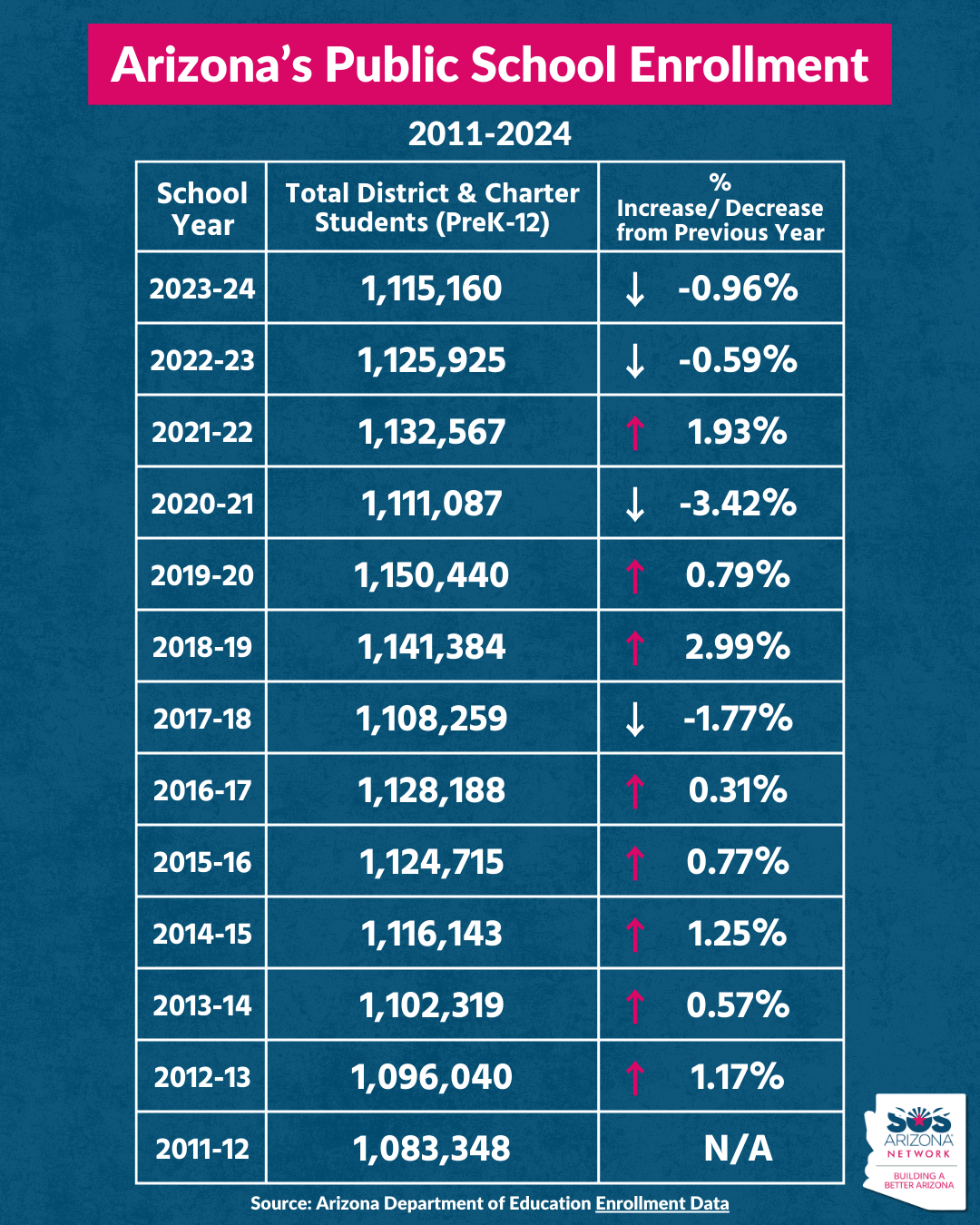
K-12 Enrollment Over Time: Arizona’s K-12 enrollment has been stable over the past 12 years, unlike many states. The below chart documents that 1,083,348 students were enrolled in Arizona’s district and charter schools in 2011-12, increasing to 1,115,160 in 2023-24. On the whole, Arizona’s public schools have served around 1.1 million students each year over the past 13 school years — and that number is not appreciably changing, despite the ESA voucher program now serving over 84,000 students. That is for one simple reason — most voucher recipients were already enrolled in private school or homeschool.
Why are Special Interest Groups Blaming Birth Rates?
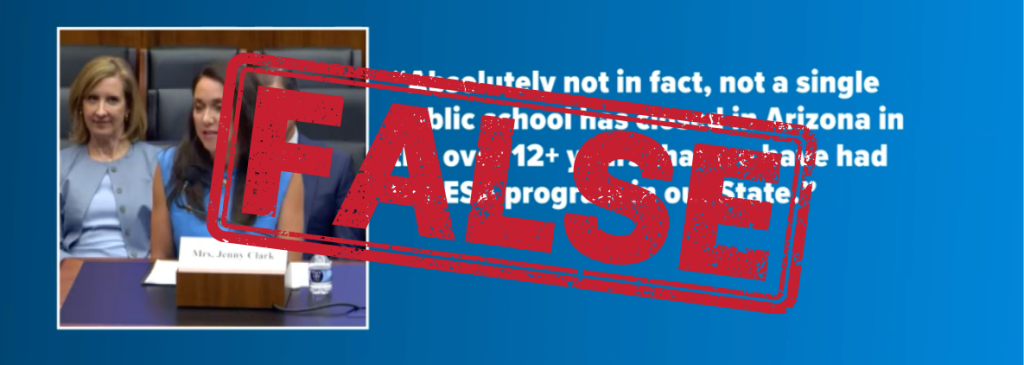
Recently, a voucher lobbyist from Arizona made the blatantly false claim to Congress that “not a single public school has closed in Arizona in the over 12 years that we have had the ESA [voucher] program in our state.”
So, why are special interest groups deflecting blame for school closures onto birth rates and enrollment rather than vouchers, which are directly siphoning the dollars needed to solve the school funding problem?
In 2022, the Goldwater Institute staked its claim that the universal ESA vouchers would have no negative impacts on local public schools, and even falsely asserted that the program would add dollars back into the classroom — a claim that is clearly not borne out. In 2023, then-Speaker of the Arizona House of Representatives Ben Toma repeatedly claimed that ESA vouchers saved Arizona money — though this claim was thoroughly debunked.
Now, lobbyists and special interests use similar bogus claims to push voucher programs in other states. They ignore the facts tying voucher expansion to public school closures since it doesn’t fit their narrative.
Will Schools Continue to Close, and What Can Be Done?
The data is clear and conclusive – Arizona’s voucher program, paired with the legislature’s chronic and purposeful underfunding of public schools, is leading to a growing number of school closures which predominantly impact Title I schools. Vouchers create an opportunity void where $1 billion is siphoned as a handout to more affluent families for private education while low-income families in public schools pay the price. Unfortunately, this trend is sure to continue until the Arizona legislature reins in the costly universal ESA voucher entitlement and establishes adequate, equitable, and stable funding for Arizona’s public schools which serve 92% of Arizona students.